
When brand identity forms before the touchpoint
The user reads the AI answer and never sees your packaging. This changes what brand identity actually means. Here's why — and what to do about it.

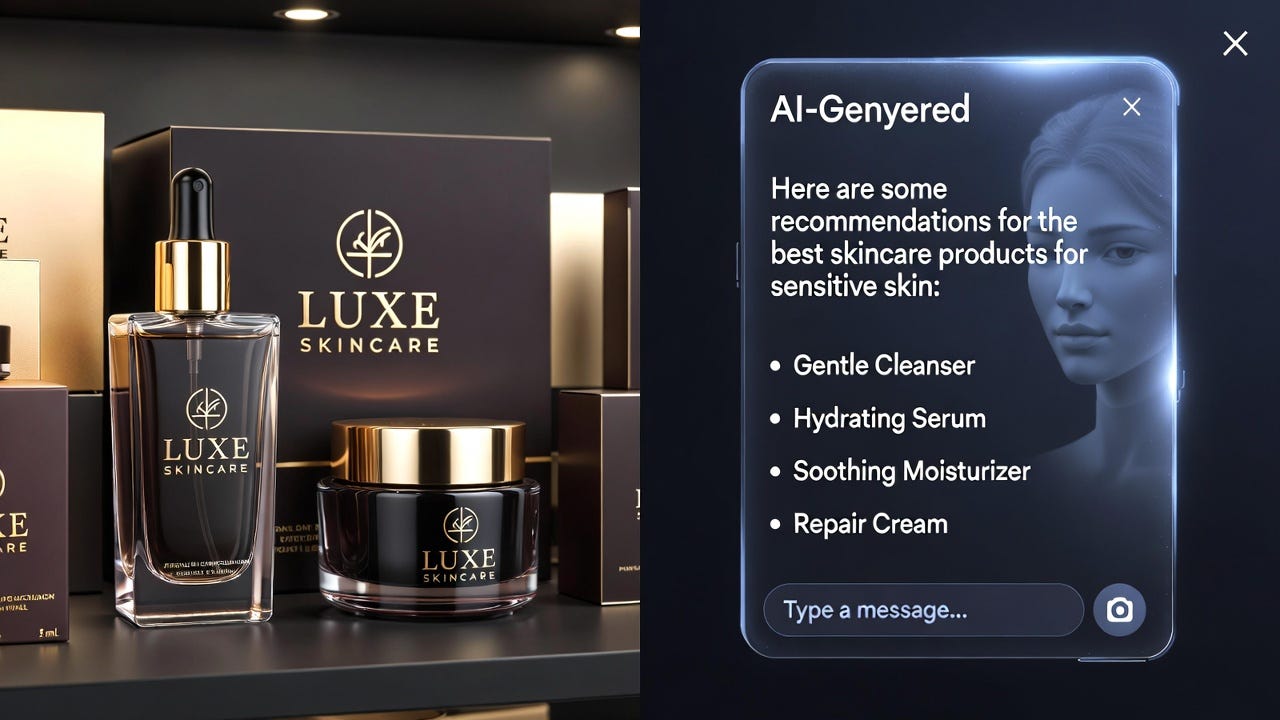
Imagine you’ve spent months on your brand’s new packaging. Color palette, evolution of the logo mark, typography, visual hierarchy, every detail carefully considered. The result is distinctive, authoritative, something your team is proud of.
Now imagine that nine out of ten users, in their first interaction with your brand, will never see that packaging.
This isn’t a hypothesis. Pew Research (July 2025) found that when an AI summary appears in Google search results, only 1% of users click through to the cited sources, and overall click-through to traditional results drops from 15% to 8% — a 47% reduction. Semrush data (September 2025) on Google’s AI Mode shows 93% of those searches end with no click at all. The direction is unmistakable. The user asks “best skincare for sensitive skin,” reads the AI answer, and moves on. Your website, your e-commerce platform, your product comparison page — for the majority of that traffic, they don’t exist.
What does exist, instead, is a second brand identity. One you didn’t design, don’t directly control, and in most cases aren’t currently measuring.
Brand identity today is doubled
Layer 1 is the classical territory of brand design: visual system, packaging, retail, website, advertising. You design it, you own it, you control it. It’s the work that got you this far.
Layer 2 is the extended digital identity: SEO, social, earned media, reviews. You influence it through content, but control is partial.
Layer 3 is new. It’s the brand as reconstructed by ChatGPT, Perplexity, Claude, and Google AI Overviews when someone asks a category-level question. It’s not indexed — it’s generated. Probabilistic, non-reproducible, influenced by what the model saw in its training data and how it memorized it.
Layer 3 is not a technical topic reserved for SEO specialists. It’s the layer where the first impression of your brand forms for a growing share of consumers. And first impressions, always, carry weight.
The numbers that change the picture
Bain & Company (February 2025) found that 80% of consumers now rely on AI-written results for at least 40% of their searches, and that 60% of searches end without any click to an external site.
The consideration set — that mental box of three or four candidate brands — is increasingly pre-filtered by an AI before the user reaches your touchpoint.
Gartner (July–August 2025) reports that 51% of consumers say their research habits have changed because of generative AI. Klaviyo’s October 2025 AI Shopping Index puts UK adoption higher: 80% of UK shoppers already use AI tools for shopping or product research, and 70% expect AI assistants to be the norm by 2026.
Seer Interactive (November 2025) measured a 61% year-over-year drop in organic click-through rate for queries where an AI Overview appears. This isn’t a marginal variation: it’s the end of the click economy for entire categories of informational search.
The BCG × Moloco Consumer AI Disruption Index (January 2026) maps 17 consumer verticals against AI-driven disruption risk and customer-relationship strength. Two-thirds of senior marketing leaders surveyed expect significant disruption to the consumer journey. News, travel, retail, and auto marketplaces sit in the highest-risk quadrant.
Peer-reviewed: it’s not just industry hype
Academic research is starting to catch up to what industry reports describe.
Lee and Park (Journal of Consumer Behaviour, 2022) demonstrate, in a structural-equation study of consumers interacting with AI shopping chatbots, that the quality of communication with the chatbot — mediated by parasocial relationship strength and satisfaction — significantly predicts whether consumers continue using the channel. The medium of the interaction shapes the relationship before any physical brand contact occurs. The chatbot is, functionally, a new packaging surface.
Khan and Mishra (Journal of Service Theory and Practice, 2023) formalize a related dynamic in a perceived AI credibility framework grounded in Source Credibility Theory. They identify four consumer-AI experience dimensions through which AI credibility shapes brand-relevant outcomes: data capture, classification, delegation, and social interaction. These are dimensions that brand teams have always designed for in other media — except now the medium carrying them is no longer a poster or a store associate but a large language model processing co-occurrence statistics in training data.
Beyond the marketing literature, a growing body of work from Stanford HAI, the University of Chicago, and Hugging Face documents systematic representational biases in how LLMs depict commercial entities and demographic groups — biases that no brand team chose and few are currently measuring.
The irony of returning to fundamentals
For two decades, digital marketing preached: optimize the funnel, personalize everything, measure CTR obsessively. Today the wind is blowing in the opposite direction.
McKinsey’s State of Marketing Europe 2026 report (November 2025) ranks branding as the number one priority for European marketing leaders in 2026, with 72% planning to increase budgets — a return to fundamentals after a decade of performance-marketing dominance.
LLMs don’t “click” — they remember.
To appear in their responses, you need to be densely present in the reference corpus: editorial coverage, authoritative reviews, listicles, papers, directories. This is exactly the classical brand building work of Byron Sharp and Mark Ritson, simply translated to the new medium.
The irony: the more AI-mediated the world becomes, the more the fundamentals of classical branding return to decisive importance. Brands that invested in sustained authority and distinctiveness get selected. Brands that chased last-quarter tactics lose visibility precisely where the new consideration set is being formed.
What changes for brand strategy
Three concrete points.
Brand identity today must be designed and measured across three layers. Layer 1 remains fundamental. Layer 2 is not superseded. But ignoring Layer 3 is like having designed the most beautiful packaging in the supermarket, in an era when most consumers no longer enter that supermarket.
The metric that matters is not just “am I cited?” but “how am I being represented?” A brand cited frequently but framed poorly is in a worse position than a brand cited less but represented with the right aspirational tone. Narrative representation — how the LLM describes you when it cites you — is where perception is formed.
The touchpoint is no longer the origin of perception, but its confirmation. When the user arrives at your site, your store, your app, the first impression has already formed in Layer 3. Your touchpoint confirms or contradicts it. When it contradicts, you lose trust before you’ve had the chance to earn it.
The question behind all of this — what is brand identity in a world where a growing share of discovery is mediated by machines? — isn’t rhetorical. It’s operational. And it’s open.
Ignoring it is no longer an option. Measuring it is becoming increasingly accessible. What’s missing — particularly in Europe — is that brand strategy teams take Layer 3 as seriously as they take packaging, retail, and campaign.
If this reflection opened a question for you, or confirmed an intuition — tell me. That’s the first step in understanding whether your brand has the problem, and how big it is.
Sources
Pew Research Center (July 2025). Google users are less likely to click on links when an AI summary appears in the results. pewresearch.org
Semrush (September 2025). AI Mode click behaviour study.
Bain & Company (February 2025). Consumer reliance on AI search results signals new era of marketing. bain.com
Gartner (September 2025). Survey on consumer trust in AI-powered search results.
Klaviyo (October 2025). AI Shopping Index — UK consumer adoption.
Seer Interactive (November 2025). Year-over-year organic CTR analysis for queries with AI Overviews.
BCG × Moloco (January 2026). Battle for the Interface: Introducing the Consumer AI Disruption Index. bcg.com
McKinsey & Company (November 2025). State of Marketing Europe 2026.
Lee, M., & Park, J.-S. (2022). Do parasocial relationships and the quality of communication with AI shopping chatbots determine middle-aged women consumers’ continuance usage intentions? Journal of Consumer Behaviour, 21(4), 842–854. doi.org/10.1002/cb.2043
Khan, A. W., & Mishra, A. (2023). AI credibility and consumer-AI experiences: a conceptual framework. Journal of Service Theory and Practice, 34(1), 66–97. doi.org/10.1108/JSTP-03-2023-0108
Luigi Greco is founder of Conflux — and is working on a solution that measures visibility and narrative representation of brands across LLMs. He has recently spoken on agentic design at the IKN IPA Conference and at the MCP Conference in New York.
Note: this post was updated shortly after publication. Some sources have been refined and a few citations tightened to match the underlying research more precisely. The thesis is unchanged.